

Views: 0 Author: Site Editor Publish Time: 2025-12-29 Origin: Site


In modern coatings technology, water‑based polyurethane (PU) stands out as a leading solution for environmentally conscious and high‑performance protective surfaces. As industries increasingly prioritize sustainability, waterborne systems are rapidly replacing traditional solvent‑based coatings. However, water‑based PU coatings face intrinsic challenges such as reduced water resistance and susceptibility to hydrolysis, which can compromise performance in humid or wet environments. To address these issues, formulators and researchers turn to the Anti‑hydrolysis Crosslinking Agent as a key performance enhancer in waterborne PU coatings. This article explores how Anti‑hydrolysis Crosslinking Agent improves water‑based PU coatings, providing data comparisons, product considerations, and trend insights for professionals and decision‑makers searching for high‑value, durable coating solutions.
Water‑based polyurethane (PU) coatings are dispersions of polymeric urethane particles in water instead of traditional organic solvents. These coatings are valued for environmental performance (lower volatile organic compounds, VOCs) and strong adhesion to many substrates. However, pure waterborne PU often faces performance drawbacks compared to solvent‑borne equivalents, particularly in mechanical strength, abrasion resistance, and hydrolytic stability. These weaknesses often arise from the dispersed nature of polymer chains and the presence of hydrophilic groups that can attract moisture.
| Characteristic | Water‑Based PU | Solvent‑Based PU |
|---|---|---|
| VOC Emissions | Low | High |
| Environmental Impact | Better | Worse |
| Mechanical Strength | Moderate | Higher |
| Hydrolysis Resistance | Lower | Higher |
| Surface Protection | Good | Very Good |
Water‑based PU coatings have become highly popular in automotive refinishing, wood finishes, and furniture due to their lower VOC emissions and safety compared to solventborne systems. Yet the need to enhance their resistance to environmental factors like moisture remains a priority.
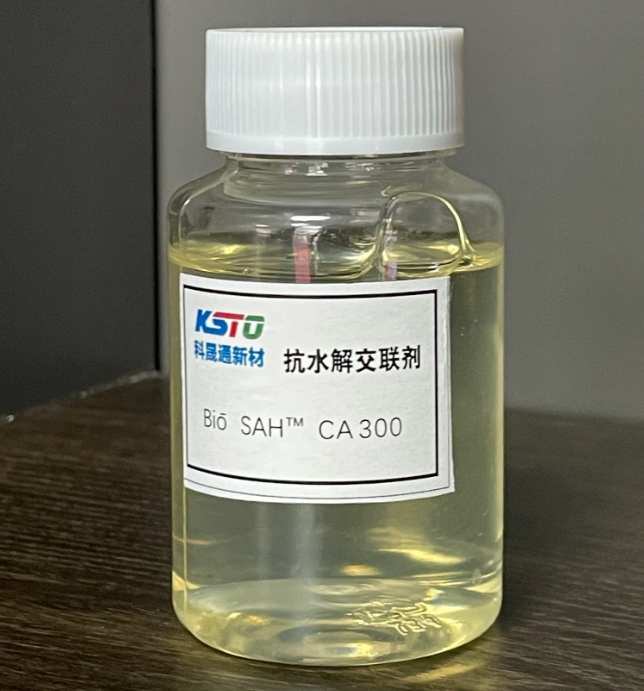
An Anti‑hydrolysis Crosslinking Agent is a type of reactive additive designed to strengthen the molecular network of water‑based PU coatings, significantly improving their resistance to hydrolytic breakdown. Hydrolysis occurs when water molecules penetrate the polymer matrix and break urethane or ester bonds, leading to crack formation, loss of adhesion, and reduced durability. Adding an Anti‑hydrolysis Crosslinking Agent helps form a robust three‑dimensional network that resists water infiltration and delays or prevents hydrolytic degradation.
Crosslinking can occur via reactive chemical groups in the agent that bond with functional groups in the PU resin. This network limits polymer chain mobility and enhances resistance to environmental stress, heat, and water.
One of the most significant benefits of incorporating an Anti‑hydrolysis Crosslinking Agent in water‑based PU coatings is improved water resistance. By creating a stronger polymer network, the agent reduces the number of hydrophilic sites available for water molecules to interact with, slowing down hydrolytic attack and preventing premature coating failure.
Proper crosslinking can significantly improve water resistance, with empirical evidence showing that coatings with effective crosslinking exhibit less swelling, fewer surface defects, and better overall integrity when exposed to moisture.
In addition to improving water resistance, Anti‑hydrolysis Crosslinking Agent improves the mechanical strength of waterborne PU coatings. These agents help form higher molecular weight structures and enhance network density, which leads to stronger coatings that resist abrasion, impact, and wear. This translates into longer service life for protective surfaces in high‑traffic or industrial environments.
Crosslinked PU coatings resist not only water but also chemical attack and heat. The strong covalent bonds created by the Anti‑hydrolysis Crosslinking Agent improve resistance to solvents, acids, and high‑temperature environments, expanding the range of applications for these coatings.
Polycarbodiimide crosslinkers are frequently used in waterborne PU systems as Anti‑hydrolysis Crosslinking Agent. These agents react with carboxyl groups in the PU resin, forming stable urethane‑like structures that resist moisture attack and enhance durability. Like other effective crosslinkers, polycarbodiimides can improve hydrolysis resistance without compromising environmental compliance.
Isocyanate‑based crosslinking agents (often blocked isocyanates) can also function as Anti‑hydrolysis Crosslinking Agent. These agents react with hydroxyl groups during curing to form a dense network that resists water penetration and mechanical stress. The blocked form allows for safe handling and controlled reactivity in waterborne systems.
Aziridine crosslinkers also serve as Anti‑hydrolysis Crosslinking Agent, reacting quickly with carboxyl and hydroxyl groups at room temperature to form crosslinks. While effective, aziridine compounds tend to be more expensive and may present toxicity concerns, so their use is less common in environmentally sensitive systems.
The coatings industry is evolving rapidly with innovations that improve performance and sustainability. Emerging trends include:
With rising regulatory pressure to reduce VOCs and toxic components, manufacturers explore bio‑based or safer chemical alternatives as Anti‑hydrolysis Crosslinking Agent solutions. These agents aim to maintain or surpass traditional performance while minimizing environmental impact.
Advanced technology research shows that combining two crosslinking mechanisms (e.g., chemical and physical crosslinking) boosts performance, including hydrolytic resistance, flexibility, and thermal stability. Such strategies can create coatings that resist acid, alkali, and salt intrusion without compromising structural integrity.
Another emerging area is self‑healing coatings that incorporate agents or microcapsules capable of repairing mechanical or hydrolytic damage autonomously. While still developmental, these systems often rely on advanced Anti‑hydrolysis Crosslinking Agent concepts integrated into intelligent polymer networks.
Manufacturers often compare coatings with and without Anti‑hydrolysis Crosslinking Agent to showcase performance improvements. Here is a representative comparison based on performance metrics commonly analyzed in industrial settings:
| Property | Water‑Based PU Without Crosslinker | With Anti‑Hydrolysis Crosslinking Agent |
|---|---|---|
| Hydrolysis Resistance | Moderate | High |
| Water Absorption | Higher | Lower |
| Adhesion After Moisture Exposure | Good | Excellent |
| Abrasion Resistance | Moderate | High |
| Solvent Resistance | Moderate | High |
Interpretation:
Coatings with Anti‑hydrolysis Crosslinking Agent show significantly improved resistance to water penetration, reduced damage from moisture, and enhanced mechanical stability, making them better suited for outdoor and industrial usage.
Choosing the appropriate Anti‑hydrolysis Crosslinking Agent depends on specific performance goals and application conditions. Consider the following parameters:
An ideal agent must be chemically compatible with the existing PU dispersion and should not destabilize the emulsion or cause phase separation.
Agents vary in their reactivity and curing requirements. For instance, blocked isocyanates require heat for activation, whereas polycarbodiimide crosslinkers can react at ambient temperatures.
Environmental regulations increasingly limit hazardous substances. Choosing a crosslinking agent that meets global environmental compliance (e.g., low VOC, non‑toxic) is crucial for modern industrial applications.
Water‑based PU coatings with Anti‑hydrolysis Crosslinking Agent are widely used in automotive exterior finishes. These applications demand excellent weatherability, abrasion resistance, and hydrolytic stability.
Crosslinked waterborne PU coatings provide durable protection against moisture, spills, and daily wear, crucial for wood finishes and furniture products.
In industrial environments where surfaces are exposed to humidity, chemicals, or thermal cycling, coatings enhanced with Anti‑hydrolysis Crosslinking Agent offer long‑lasting protection.
High‑performance flooring often requires PU coatings that resist water, mechanical stress, and chemical contact. Crosslinkers boost these performance aspects effectively.
Data from industry tests consistently show that coatings with appropriate Anti‑hydrolysis Crosslinking Agent formulations outperform traditional waterborne PU in accelerated weathering, salt‑spray exposure, and hydrolysis testing. For example, coatings formulated with advanced crosslinkers can withstand moisture exposure for hundreds of hours without loss of adhesion or gloss.
Below is a summary of typical comparative data from accelerated hydrolysis tests:
| Test Condition | Without Crosslinker | With Anti‑Hydrolysis Crosslinking Agent |
|---|---|---|
| 168‑Hour Humidity Chamber | Significant degradation | Minimal change |
| 500‑Cycle Wet‑Dry Test | Reduced adhesion | Maintained adhesion |
| Salt Fog Spray Test | Corrosion streaks present | Strong corrosion resistance |
These trends confirm that crosslink‑enhanced coatings are better suited for environments with high moisture or corrosive atmospheres—a critical consideration for product specification and customer satisfaction.
To maximize the benefits of Anti‑hydrolysis Crosslinking Agent, formulators should follow these best practices:
Too little crosslinker may not achieve desired performance; too much can lead to brittleness or processing complications. Testing must determine an optimal balance.
Ensure that curing conditions (temperature, humidity, time) align with the crosslinking agent’s requirements for full network formation.
Beyond basic performance tests, advanced characterization (e.g., FT‑IR analysis, hydrolysis resistance measurement) helps quantify the impact of the crosslinker on coating durability.
As market demand for both high performance and environmental responsibility grows, Anti‑hydrolysis Crosslinking Agent technologies will continue to evolve. Researchers and manufacturers are exploring next‑generation agents that combine hydrolytic resistance with improved flexibility, recyclability, and reduced environmental impact. Integration with nanotechnology, bio‑based chemistries, and smart materials represents a frontier in waterborne PU coating development.
1. What is the primary function of an Anti‑hydrolysis Crosslinking Agent in water‑based PU coatings?
The main role is to enhance the coating’s resistance to hydrolysis by forming a stronger polymer network that resists water molecule infiltration and protects against moisture‑induced degradation.
2. How does Anti‑hydrolysis Crosslinking Agent improve mechanical properties?
By increasing the crosslink density within the polymer structure, the coating becomes more rigid and durable, improving abrasion and impact resistance.
3. Are all crosslinkers effective as Anti‑hydrolysis agents?
No. Only agents with reactive groups that can bond effectively with PU functional groups under curing conditions will deliver meaningful hydrolysis resistance.
4. Can Anti‑hydrolysis Crosslinking Agent be used in all water‑based PU applications?
Yes, but formulation must be optimized for each application to balance flexibility, adhesion, and resistance properties.
5. What trends are shaping the future of crosslinking in waterborne PU coatings?
Emerging trends include bio‑based crosslinkers, dual‑crosslinking strategies, and smart self‑healing systems that further enhance performance while reducing environmental impact.
