

Views: 0 Author: Site Editor Publish Time: 2026-03-01 Origin: Site


You have many choices when picking an ultraviolet absorber solution for your products. The best ones are KST-UV1600, KST-UV312, benzotriazoles, triazines, and benzophenones. These ultraviolet absorber solutions keep materials safe from harmful ultraviolet rays. They are very important in coatings, plastics, and adhesives.
Benzophenone was used the most in 2023.
Benzotriazole and triazine types are also growing fast in coatings and adhesives.
The adhesives area is getting bigger quickly.
The right ultraviolet absorber solution depends on how it absorbs light, how stable it is, if it works with resins, and if it is safe. You need to pick the ultraviolet absorber that fits your needs. This helps protect your products from ultraviolet light and keeps them good for a long time.
| Performance Criteria | Description |
|---|---|
| Absorption Spectrum | Takes in UV light in certain ranges to stop damage. |
| Chemical Stability | Stays strong over time, even with heat, light, and water. |
| Compatibility with Resin | Does not hurt your materials or how you make them. |
| Toxicological Profile | Safe to use and does not harm the environment much. |
When you choose an ultraviolet absorber solution, think about new options like KST-UV1600 and KST-UV312. They have special benefits like taking in more UV, not turning into gas easily, and staying strong in heat. These things help your products last longer and stay safe from ultraviolet stabilizers.
Pick the best ultraviolet absorber by looking at its absorption spectrum, how stable it is, if it works well with other materials, and if it is safe. This helps keep your products safe.
KST-UV1600 and KST-UV312 give great UV protection. They can handle high heat. They also mix well with many polymers. This makes them good for lots of uses.
Benzotriazoles and triazines are used a lot in coatings and adhesives. They give strong UV protection and last a long time.
You should always test if UV absorbers work with your materials. This makes sure everything is protected and stops problems with your products.
Think about both the price and safety rules when you pick UV absorbers. This helps your products follow the rules and be a good value.
Ultraviolet (UV) absorbers help protect materials from sunlight. These chemicals stop UV rays from hurting plastics and coatings. Their special structure lets them absorb UV light. UV absorbers have conjugated π-electron systems and ortho-hydroxyphenyl groups. These parts help them make chelate rings. Chelate rings are important for absorbing UV light.
When a UV absorber gets sunlight, it changes the energy. The molecule takes in UV energy and breaks a hydrogen bond inside. This makes the molecule change shape and vibrate. It turns dangerous UV energy into safe heat. This process is called photoisomerization or excited-state intramolecular proton transfer (ESIPT). It keeps materials safe by stopping UV rays from breaking polymer chains.
Tip: Using advanced UV absorbers like KST-UV1600 and KST-UV312 gives strong protection. KST-UV1600 has low volatility, high absorption, and resists heat. KST-UV312 absorbs UVB well and works with many resins.
UV absorbers are used in many industries. They help products last longer and look better. Without UV absorbers, sunlight can make plastics brittle and fade colors. It can also weaken coatings. UV absorbers stop this damage and keep products strong.
Here are some industries that use UV absorber solutions:
Automotive & Transportation
Building & Construction
Agriculture
Electronics & Electrical Appliances
Packaging
Textiles & Apparel
Sports & Leisure
Household Goods & Toys
Renewable Energy
Personal Care
Healthcare & Medical
Fuels & Lubricants
KST-UV1600 works in high-performance polymers like PET, PBT, PC, PMMA, and more. KST-UV312 fits well with PA, PC, PVC, PU, and PET/PBT resins. Picking the right UV absorber helps your products stay protected and perform well in tough places.
There are many types of uv stabilizers in industry. Each type protects products from sunlight in its own way. The main chemical classes are benzotriazoles, triazine, benzophenones, and oxalanilides. These uv stabilizers help you pick the best one for your needs.
Here is a table that shows how each class’s structure affects how well it works:
| Chemical Class | Examples | Structural Influence |
|---|---|---|
| Organic UV Absorbers | Benzophenones, Benzotriazoles, Triazines | Intramolecular hydrogen bonds absorb UV and turn it into heat. |
| Inorganic UV Absorbers | TiO2, SiO2, ZnO | Band gap absorption and light scattering help block UV. |
| Natural UV Absorbers | Plant extracts | Natural compounds absorb UV and protect materials. |
Triazine-based uv absorbers are known for strong UV protection. Triazine has a special ring shape that absorbs UV light very well. Benzotriazole and benzophenone are also common uv stabilizers. Organic uv absorbers like triazine work well in plastics and textiles. You can use these uv stabilizers to keep products safe from UV damage.
Some uv stabilizers are used in many industries. Here are some important ones:
KST-UV1600
Chemical component: 2-14,6-Bis([1,1-biphenyl]-4-y)-1,3,5-triazin-2-y1-5-[(2-ethylhexyoxy]phenol
CAS NO.: 204583-39-1
Main features: low volatility, strong absorption, high heat resistance, light color transparency
Application fields: PET, PBT, PC, PMMA, acrylic copolymer, PA, PS, SAN, ASA, and more
This product uses triazine-based uv absorbers for long-lasting protection.
KST-UV312
Chemical component: N-(2-ethoxyphenyl)-N-(2-ethylphenyl)oxamide
CAS NO.: 23949-66-8
Main features: strong UVB absorption, good compatibility, low volatility, high absorption
Application fields: PA, PC, PVC, PU, PET/PBT resin, powder coating, solvent coating
This product is a good choice if you need uv stabilizers that work with many resins.
Other popular products are UV-400, UV-531, and UV326. These use benzotriazole, benzophenone, or triazine as their main chemical class. Triazine-based uv absorbers are found in many high-performance solutions. Triazine gives strong UV protection and works well in many polymers.
Note: When picking uv stabilizers, check if the product uses triazine. Triazine-based uv absorbers often give the best weather resistance and durability.
You can use triazine-based uv absorbers in coatings, adhesives, and plastics. These uv stabilizers help products last longer and look better. Triazine is important for modern UV protection.
Picking the right uv absorber helps your products work better. You should check things like how much light it absorbs, how well it works, if it stays strong in heat, how long it lasts, if it mixes well, how much it costs, and if it is safe. This comparison shows how KST-UV1600, KST-UV312, benzotriazoles, triazines, and benzophenones stack up.
You want an absorber that blocks lots of uv rays. This keeps your materials safe from damage. KST-UV1600 and KST-UV312 absorb lots of UVB rays. UVB rays are important for strong plastics and coatings. Benzotriazoles and benzophenones also block UVB, but their ranges are not the same.
Here is a table showing the absorption ranges for common uv absorbers:
| UV Absorber Type | Wavelength Range (nm) |
|---|---|
| KST-UV1600 | 280-400 |
| KST-UV312 | 280-320 |
| Benzotriazole | 280-320 |
| Benzophenone | 290-320 |
| Triazine | 280-400 |
KST-UV1600 and triazine cover more wavelengths. This gives your products better protection. KST-UV312 works well in the UVB range. This is good for many plastics and coatings.
You can see how absorbers work in real tests. Using UV-400 in polycarbonate doubles outdoor life. In acrylic, haze goes down by three times. In polyamide, mechanical life gets longer by 1.5 times. These results show why picking the right absorber matters.
Here is a chart that compares color change, gloss retention, and tensile strength for several uv absorbers:
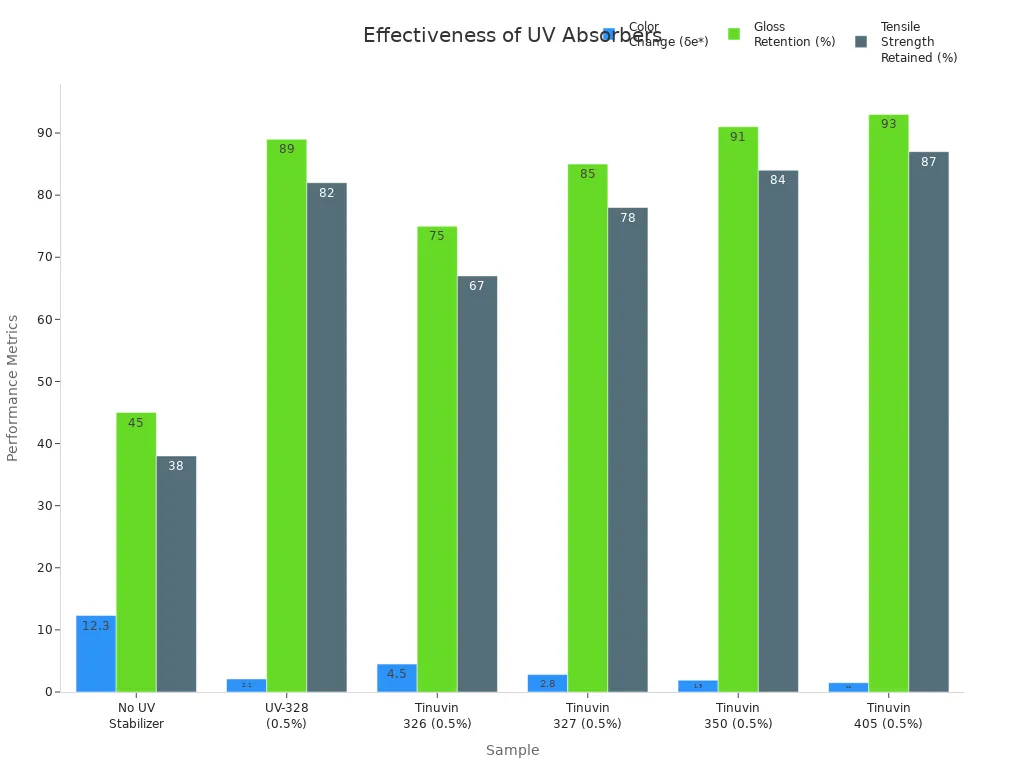
Using a good absorber keeps your products looking new and strong for longer.
Thermal stability matters if you use high heat. KST-UV1600 and KST-UV312 stay strong in heat. They do not break down easily. Benzotriazoles also stay strong, especially in PVC. Benzophenones break down faster, so they are best for easier jobs.
Here is a table that shows how some absorbers rate for thermal stability:
| UV Stabilizer | Thermal Stability |
|---|---|
| KST-UV1600 | High |
| KST-UV312 | High |
| Benzotriazole | High |
| Benzophenone | Moderate |
| Triazine | High |
Durability is important for products in sunlight. KST-UV1600 and triazine help materials last longer outside. They keep colors bright and surfaces smooth. In coatings, these absorbers help finishes stay nice. In adhesives, they keep materials flexible and strong.
In coatings, absorbers make outdoor surfaces last longer.
In adhesives, they stop cracking and loss of strength.
You need an absorber that mixes well with your resin. KST-UV1600 works with many polymers like PET, PBT, PC, PMMA, and more. KST-UV312 fits PA, PC, PVC, PU, and PET/PBT resins. Benzotriazoles mix well with PVC and block UV over a wide range. Benzophenones are best for plastics with little or no color.
Mixing an absorber with a polymer needs good compatibility. If it does not mix well, it can form lumps and not work right. About 70% of absorbers work best when mixed well with the polymer. Always test compatibility before making lots of products.
Benzotriazoles are good for PVC.
Benzophenones are used in older systems.
KST-UV1600 and KST-UV312 work with many modern resins.
Good compatibility means your absorber protects your product evenly and for a long time.
Cost matters when picking an absorber. Benzotriazoles cost $15 to $60 per kilogram. Other absorbers cost more or less based on how pure and strong they are. KST-UV1600 and KST-UV312 give good value because they last longer and cut down on replacement costs.
Safety is just as important as cost. You want an absorber that follows strict safety rules. North America and Europe have strong rules for safe UV ingredients. Companies now test for health and environmental safety. New absorbers like KST-UV1600 and KST-UV312 meet these rules and are safer.
Here is a table that summarizes safety and regulatory trends:
| Aspect | Details |
|---|---|
| Regulatory Influence | Strong rules in North America and Europe for safe UV absorbers |
| Toxicological Testing | More testing for health and environmental safety |
| Market Growth | Global market for advanced absorbers is growing quickly |
New technology makes absorbers safer and better for you and your customers.
You can use this table to compare the main features of each absorber:
| Absorber Type | Absorption Range (nm) | Thermal Stability | Polymer Compatibility | Cost ($/kg) | Safety Profile |
|---|---|---|---|---|---|
| KST-UV1600 | 280-400 | High | PET, PBT, PC, PMMA, etc. | Varies | Meets global standards |
| KST-UV312 | 280-320 | High | PA, PC, PVC, PU, PET/PBT | Varies | Meets global standards |
| Benzotriazole | 280-320 | High | PVC, general plastics | 15–60 | Widely approved |
| Benzophenone | 290-320 | Moderate | Light-colored plastics | 15–60 | Older technology |
| Triazine | 280-400 | High | Many polymers | Varies | Modern, safe |
This comparison shows that KST-UV1600 and KST-UV312 are great for tough jobs. They block lots of uv rays, stay strong in heat, and mix well with many resins. You can count on these absorbers to protect your products for a long time.
Ultraviolet absorbers are used in many coatings. These additives protect surfaces from sunlight. They help keep colors bright. Benzoate, benzophenone, and benzotriazole UV absorbers are found in industrial coatings. Some common compounds are N-(Ethoxycarbonylphenyl)-N'-methyl-N'-phenyl formamidine and 2-Hydroxy-4-n-octoxybenzophenone. UV absorbers can make coatings last up to 50% longer. They help stop yellowing and cracking. Coatings with UV stabilization show less damage in weathering tests. KST-UV1600 and KST-UV312 are used in automotive and powder coatings. These coatings last longer and look better.
Ultraviolet absorbers are important in plastics and polymers. They protect materials from sunlight. This helps plastic products last longer. Here is a table showing common UV absorbers and their uses:
| UV Absorber Type | Characteristics | Applications |
|---|---|---|
| Titanium Oxide | Works well in many uses. | Plastics, coatings |
| Carbon Black | Makes products stronger. | Plastics, coatings |
| Benzophenones | Absorbs UV strongly, not very toxic. | Plastics, coatings |
| Triazoles | Very efficient, absorbs harmful UV. | Plastics, coatings |
Adding UV absorbers improves mechanical properties. They keep polymer matrices stable and stop photooxidation. KST-UV1600 and KST-UV312 protect PET, PBT, PC, PMMA, and other polymers.
UV absorbers help adhesives and sealants stay strong. Organic UV absorbers like Everstab 327 absorb UV well. Inorganic types last longer over time. UV absorbers protect adhesives from sunlight and stop them from breaking down. Light stabilizers, like hindered amine light stabilizer, work with UV absorbers to turn UV energy into heat. This keeps adhesives flexible and tough. KST-UV312 works well in PU and PVC adhesives.
UV absorbers are used in textiles and films to protect fibers and surfaces. UV-531 is used in outdoor textiles and farm films. Nanostructured ZnO films give cotton textiles high UV protection. UV absorbers change UV light into heat, which lowers damage. Hindered amine light stabilizer and other additives help improve UV resistance. Thick films and even coatings block UV rays better. KST-UV1600 is used in acrylic copolymer films and makes them last longer in many uses.
When you pick anti-uv aging agents, you need to think about how well they work and how much they cost. You want your products to last longer and not get damaged by sunlight. Here are some steps to help you choose the best one:
Pick the right kind of anti-uv aging agent. The type you choose will change how your product works.
Think about where your product will be used. Some places have stronger sunlight, so you need better uv aging resistance there.
Change your material formula if needed. This can help your product work better and last longer.
Look at both cost and performance. You want to save money but also make sure your product is good enough for the market.
You can use this table to see how different anti-uv aging agents compare in cost and performance:
| Grade | UV Protection | Thermal Stability | Yi Reduction (%) | Compatibility | Durability | Cost Level | Environmental Profile |
|---|---|---|---|---|---|---|---|
| Tinuvin 328 | ★★★★☆ | ★★★ | 70–85 | Good | Medium | Medium | Moderate |
| Tinuvin 1130 | ★★★ | ★★★★ | 60–75 | Excellent | High | High | Low |
| Chimassorb 944 | ★★★★ | ★★★★★ | 80–95 | Very Good | Very High | High | Moderate |
| Irganox 565 | ★★★ | ★★★ | 65–80 | Good | Medium | Medium | High |
| Uvinul 4049 HD | ★★★★★ | ★★★★ | 90–97 | Good | High | High | Moderate |
KST-UV1600 and KST-UV312 are special because they absorb a lot of UV, can handle high heat, and mix well with many polymers. These things help you get the most for your money.
You need to check if your anti-uv aging agents follow important rules. Different countries have their own rules. These rules keep people and the environment safe. Here is a table that shows some main rules:
| Regulatory Framework | Key Requirements | Implications |
|---|---|---|
| REACH (EU) | Chemical safety standards | Higher costs and possible delays in getting products ready |
| TSCA (U.S.) | Chemical substance regulation | More testing and sometimes new formulas |
| Food-contact/cosmetic-grade | Safety and performance testing | Fewer choices and more investment in new chemistries |
You should always think about safety and the environment when you pick anti-uv aging agents. This helps your products stay safe and trusted by customers.
Choosing the right supplier is very important for your success. You want a partner who gives you more than just products. Here are some things to look for:
Many products and new ideas.
Strong performance and stable anti-uv aging agents.
Products that follow world rules.
Reliable supply and can handle big orders.
Good customer service and technical help.
Fair prices and good value.
A good reputation and happy customers.
Focus on making products that are good for the environment.
Many top suppliers, like BASF and Clariant, give technical help and custom solutions. They help you fix problems and make your uv aging resistance better. KST-UV1600 and KST-UV312 suppliers can help you pick the right agent for your needs.
Tip: Work with suppliers who give local support and know your industry. This makes it easier to get help and keep your products strong.
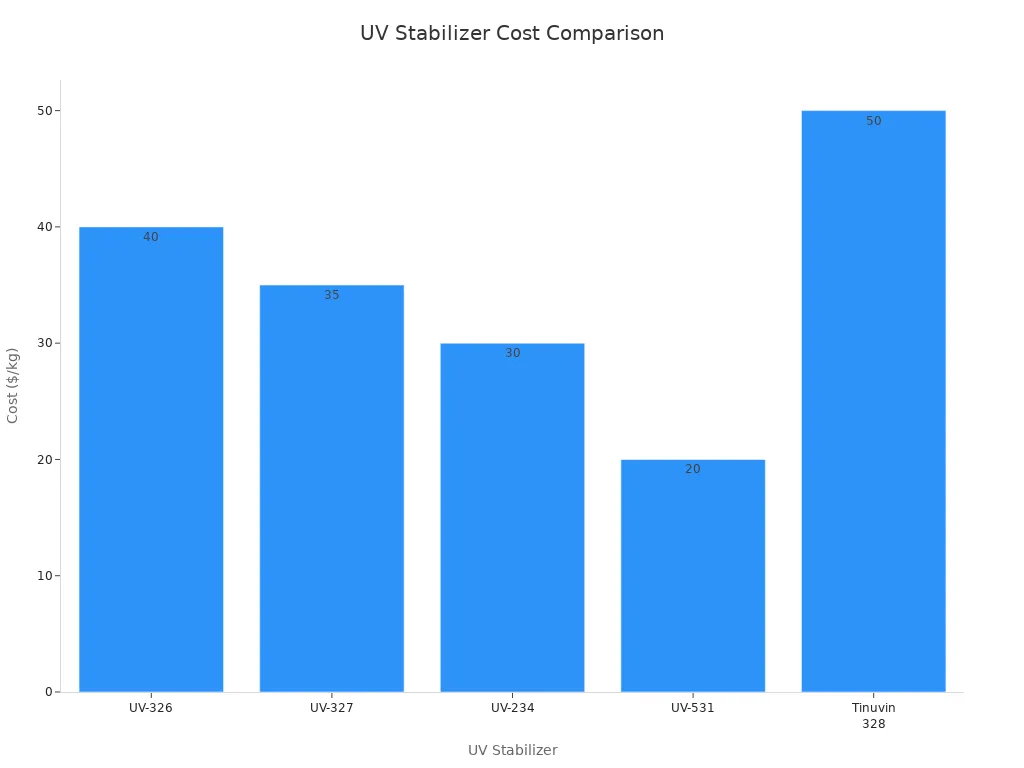
KST-UV1600 and KST-UV312 give strong UV protection. They last a long time and mix well with many polymers. You can look at this table to compare UV stabilizers:
| UV Stabilizer | Effectiveness | Durability | Cost | Application Suitability |
|---|---|---|---|---|
| KST-UV1600 | Excellent | Outstanding | Varies | High-performance polymers |
| KST-UV312 | Excellent | Outstanding | Varies | PA, PC, PVC, PU, PET/PBT |
| UV-326 | High | Excellent | $40/kg | Automotive, packaging |
| Tinuvin 328 | Exceptional | Outstanding | $50/kg | High-performance |
To pick the right anti-UV aging agent, follow these steps:
Make sure your processing method fits. Add agents early so they spread out well.
Change formulas to fit where your product will be used.
Do not mix with things that fight against each other.
Pick single or compound systems for the best results.
Think about what your product needs. Talk to suppliers to get solutions that fit you.
KST-UV1600 gives you low volatility, strong UV absorption, high heat resistance, and clear color. You can use it in many high-performance polymers. It helps your products last longer outdoors and keeps them looking new.
You can use KST-UV312 in polyamide, polycarbonate, PVC, PU, and PET/PBT resins. It works well in powder coatings and solvent coatings. This UV absorber fits many plastics and coatings in cars, electronics, and packaging.
Both KST-UV1600 and KST-UV312 absorb harmful UV rays. They turn UV energy into safe heat. This stops sunlight from breaking down plastics and coatings. Your products stay strong and keep their color longer.
Yes. Both products meet global safety standards. You can use them in many industries. They do not react with metal ions or interfere with other additives. This makes them safe for your production process.
High compatibility means the UV absorber mixes well with your resin. This gives even protection. You avoid lumps or weak spots. Your final product stays strong and looks good for a long time.
